A battle of words, a war of wits

image

Content:

Eight writers put on boxing gloves — metaphorical ones, at least — and entered the ring Monday night to face off in a tournament to crown the best wordsmith in Halifax.

Image

The winners were determined by a good-ol’-fashioned cheer-off in each round.

Write For Your Life! was held as a fundraiser for the Doppler Effect, an independent Halifax theatre company run by Michael McPhee and Annie Valentina.

“We basically set it up as a writer death tournament similar to the Ultimate Fighting Championship one, where they were pitting style versus style,” says McPhee, “pitting playwrights against poets against screenwriters and novelists and then have a showdown to see who would be the greatest.”

McPhee and Valentina put out a cold call to members of the local arts community to find contenders.

“A lot of writers were scared to enter into a writer death match,” says McPhee, making it hard to find “people brave enough to step into the ring.”

The Bus Stop Theatre on Gottingen Street was filled with people eager to participate, as the winners were decided by applause.

“We paired up the writers and gave them juxtaposed topics to write on,” says McPhee.

Gary Williams, who runs the locally independent DaPoPo Theatre, and McPhee himself started off the first round.

Williams had the topic “old” and McPhee the topic “new.”  Other topics included dawn versus dusk and fire versus ice.

The works presented ranged from stand up, short-stories, spoken word and everything in between. The contenders were given the topics in advance for the first round and ready to go the distance.

“What we try to do as a company a lot is to bridge the gap between different art scenes and different kinds of entertainment,” says Valentina. “So this is kind of a great opportunity to unify the communities.”

After four contestants were eliminated in the first round, the four remaining survivors were given a topic on the spot and in a lightning round had 20 minutes to write and prepare a piece for the audience.  The topics were reason versus passion and reality versus fantasy.

Williams and comedian Megan McDowell battled in the final round. The final contestants could choose a topic to write about but McPhee and Valentina read the pieces on behalf of the finalists.

Williams’ piece, read by Valentina was a hypothetical look at gay sex in movies. “Sex romance, temporary breakup, and in the end love again,” said Valentina. “It’s love between men but the 21st-century audience can see love between men is no longer taboo.”

McDowell wrote a stream of consciousness about being too lazy to prepare anything for the third round.

“If only there was Metamucil for the brain and you could just mix up a glass of water and fibre and take a huge word shit,” said McPhee, reading McDowell’s entry.

The competition was close  — master of ceremonies Kevin Kinder had to conduct the cheer off three times to crown McDowell the winner.

Write for Your Life! will help  support The Doppler Effect’s upcoming productions, “Alien” and “Heartwood,” one-woman shows playing in January at the Neptune Scotiabank Studio Theatre.

By Hanna Petersen: Published in the Halifax Commoner on December 4, 2013.

Disability act on radar for Nova Scotians

image

Content:

People with disabilities have the right to live in a barrier-free society but, for many people, equal access to services is limited at best.

Nova Scotia is on the road to become the third province to pass a disabilities act that would ensure accessibility.

The new Liberal government made a promise in the election to pass an Accessibility for Nova Scotians with Disabilities Act.

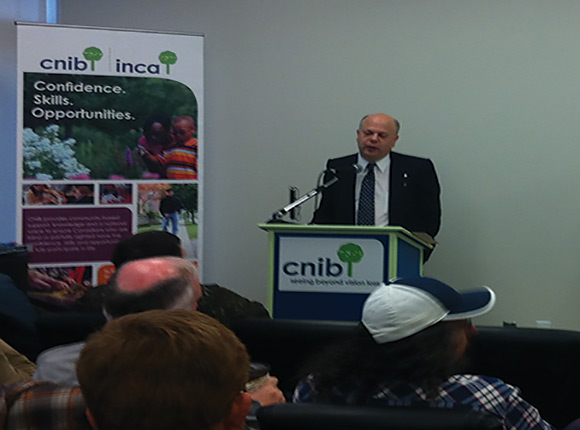
David Lepofsky, an Ontario lawyer, author and motivational speaker who is blind, spoke this week at the Canadian Council of the Blind’s Advocacy and Awareness Chapter’s public meeting in Halifax.

Image

Author, lawyer and motivational speaker David Lepofsky is encouraging Nova Scotians to be advocates for a provincial disability act.

He declared the meeting the birth of the Nova Scotians with Disabilities Act movement.

“Most people running programs don’t have a disability themselves. Even if they think about us they don’t know what to do,” says Lepofsky.

“We need a law that makes sure the standards of accessibility that are set are informed by the real life experience of people with disabilities who face these barriers.”

Lepofsky,  discussed strategies for advocating for a strong disability accessibility law for Nova Scotia.

He gave his recommendations to ensure that this act becomes a reality in Nova Scotia.

“Imagine walking into a government health office, white cane in hand, and having the very nice clerk hand you a number and say ‘Watch the screen for when your number comes up,’” says Lepofsky.

“People with disabilities face barriers in this country every single day of their lives.  We have a right to live in a society free of barriers.

“That’s not just me speaking that is what the equality rights of our constitution says and that is what the human right’s code of every single province says.”

This is not a new idea in Nova Scotia.

Pat Gates, chair of the Canadian Council of the Blind Advocacy and Awareness Chapter says the Disabilities Strategy Partnership, which works with 22 provincial disability groups, has been working since 2009 to get a disabilities act passed.

“Persons with disabilities deserve to have the same access as persons without disabilities and we are not anywhere near that at this time,” says Gates.

“Persons with disabilities need to make up over half of any committee because we are the first voice. We can tell you exactly the inaccessible things that we come across because we live with it 24/7.”

Gates is legally blind. She says that because she has a white cane people often assume she can’t speak or think for herself.

“A lot of obstacles that persons with disabilities face is the false assumption that we can’t live like normal everyday people,” she says. “We are normal everyday people we just happen to have a disability.”

Lepofsky led a 10-year campaign in Ontario to get the province to pass a disabilities act. In 2001, Ontario became the first province in Canada to do so.  He now leads the coalition that advocates to have the Accessibility for Ontarians with Disabilities Act effectively enforced.

Lepofsky encourages Nova Scotians to use Ontario’s act as a model, improve it and shape it for the province.

That’s what a group in Manitoba did and now Lepofsky says he understands a disabilities act will be passed in Manitoba by the end of the year.

Prior to the implementation of Ontarians with Disabilities Act in 2005, Lepofsky sued the Toronto Transit Commission (TTC) to announce all subway stops for the benefit of blind passengers.

After five years, he won.

Lepofsky says he had to sue the TTC a separate time in order to get them to announce all bus stops.

Lepofsky has given training to people with disabilities and their supporters across Ontario and elsewhere on how to win positive change, but that’s not enough.

“There are too many barriers and we will never get them all removed if we leave it to individuals with disabilities to have to sue one barrier at a time,” he says.

Lepofsky says barriers come about because organizations overlook people with disabilities. He says the disability act is designed to get people thinking about barriers early so problems are prevented before they happen.

A disability act would set accessibility standards which businesses and organizations would be forced to follow.

Dorothy Kitchen, co-chair of the Disability Strategy Partnership, says accessibility goes beyond ramps and the Access-A-Bus. It’s about having the technical aids needed to live independently.

Kitchen’s daughter uses a communication aid. With all of the accessories, it cost more than $20,000.

She received the device through charity and a church fundraiser because there were no options for any kind of government assistance

“Those are things that in other provinces they are covered in a lot of instances. That equipment should have been covered according to the convention,” says Kitchen.

This convention is the United Nations Convention on the Rights of Persons with Disabilities.

Article 26 of the convention states assistive technologies should be made accessible.

By Hanna Petersen: Published in the Halifax Commoner on November 7 2013.

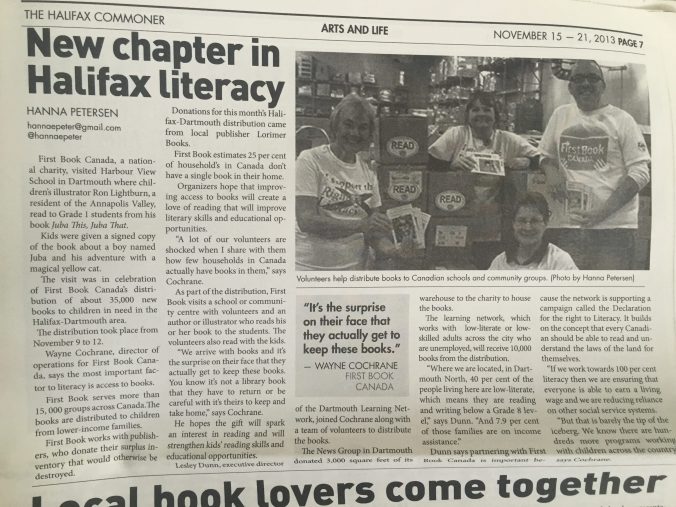
A new chapter in Halifax literacy

image

Content:

First Book Canada, a national charity, visited Harbour View School in Dartmouth where children’s illustrator Ron Lightburn, a resident of the Annapolis Valley, read to Grade 1 students from his book Juba This, Juba That.

Kids were given a signed copy of the book about a boy named Juba and his adventure with a magical yellow cat.

The visit was in celebration of First Book Canada’s distribution of about 35,000 new books to children in need in the Halifax-Dartmouth area.

Image

Volunteers help distribute books to Canadian schools and community groups.

The distribution took place from November 9 to 12.

Wayne Cochrane, director of operations for First Book Canada, says the most important factor to literacy is access to books.

First Book serves more than 15, 000 groups across Canada. The books are distributed to children from lower-income families.

First Book works with publishers, who donate their surplus inventory that would otherwise be destroyed.

Donations for this month’s Halifax-Dartmouth distribution came from local publisher Lorimer Books.

First Book estimates 25 per cent of household’s in Canada don’t have a single book in their home.

Organizers hope that improving access to books will create a love of reading that will improve literary skills and educational opportunities.

“A lot of our volunteers are shocked when I share with them how few households in Canada actually have books in them,” says Cochrane.

As part of the distribution, First Book visits a school or community centre with volunteers and an author or illustrator who reads his or her book to the students. The volunteers also read with the kids.

“We arrive with books and it’s the surprise on their face that they actually get to keep these books. You know it’s not a library book that they have to return or be careful with it’s theirs to keep and take home,” says Cochrane.

He hopes the gift will spark an interest in reading and will strengthen kids’ reading skills and educational opportunities.

Lesley Dunn, executive director of the Dartmouth Learning Network, joined Cochrane along with a team of volunteers to distribute the books.

The News Group in Dartmouth donated 3,000 square feet of its warehouse to the charity to house the books.

The learning network, which works with low-literate or low-skilled adults across the city who are unemployed, will receive 10,000 books from the distribution.

“Where we are located, in Dartmouth North, 40 per cent of the people living here are low-literate, which means they are reading and writing below a Grade 8 level,” says Dunn. “And 7.9 per cent of those families are on income assistance.”

Dunn says partnering with First Book Canada is important because the network is supporting a campaign called the Declaration for the right to Literacy. It builds on the concept that every Canadian should be able to read and understand the laws of the land for themselves.

“If we work towards 100 per cent literacy then we are ensuring that everyone is able to earn a living wage and we are reducing reliance on other social service systems.”

By  on 

Halifax couple offers new approach to seniors’ recreation

image

Content:

Michael McCurdy saw the quality of his mother’s life lessen after she moved into a retirement home in her mid-eighties.  McCurdy took her out for walks in the park and to the art gallery, even though she was losing her sight.

His wife, Susan, says they saw her life diminishing in stimulation, enrichment, and happiness.

Image

Michael and Susan McCurdy created the Halifax Seniors Happiness Project to bring happiness and joy into seniors’ lives.

Inspired by this experience, and after three years of research, in the spring the McCurdys created the Halifax Seniors Happiness Project to bring joy back into seniors’ lives.

The idea is to get small groups of seniors out of their homes for the day and engaged in activities they enjoy.
People over the age of 75 have a higher risk of psychological stress than younger seniors because they are more prone to social isolation, says a 2006 study by Statistics Canada, A Portrait of Seniors in Canada.

The McCurdys are younger seniors themselves. Michael, 64, and Susan, 63, are involved in seniors’ organizations and activities.Michael McCurdy is a retired teacher and Susan McCurdy is retired from a career in the education field.

Now Susan McCurdy is a member of the Seniors College Association of Nova Scotia and her husband sits on the board of Spencer House, a seniors’ centre that encourages and supports healthy, independent lifestyles.

The McCurdys say one of the best events they’ve done was having a client, who was tired of her meals-on-wheels options, over to their house for Thai food.  “We laughed and I think we sat here ’til 10 o’clock until we finally took her home,” says Michael McCurdy. He says another memorable outing was taking a group of three women to the Annapolis Valley Apple Blossom Festival.

The project is a door–to-door service. The McCurdys pick up the participants at their homes, take them to an event, maybe for tea afterwards and then take them home.

“We want to take people out and be a part of the community. I think it’s kind of depressing to stay home all day alone,” says Susan McCurdy.

In August, the National Seniors Council, an organization established to advise the government of Canada on matters related to the quality of life of seniors, announced its priority for 2014 is to assess how social isolation affects seniors and explore ways to reduce it.

The McCurdys’ biggest hurdle is overcoming the reluctance of some seniors to get involved.  “Seniors just don’t want to spend money on themselves and that has been a big challenge for us,” says Susan McCurdy. They charge $25 for an outing, to cover the cost of transportation.

“Honestly, the idea is not to make a profit of this but we are retired, we live on a pension so we can’t really do it for free.”

The McCurdys hope to find some source of funding so they can offer the service for free. They haven’t looked into it but they say it’s the next step.

“If we could get some kind of grant, if we could say to people, ‘come on, it won’t cost you a thing. We will pick you up,’ we would love to do that,” says Susan McCurdy.  They have been able to help half a dozen seniors since they launched in the spring.  They take seniors to lectures at the libraries, to art galleries, or even on day trips to Peggy’s Cove.

Michael McCurdy says when he asks seniors what they need in their lives, it’s always the same answer. “‘I don’t want to be alone. I want to be with people.’”

By Hanna Petersen on November 27, 2013.

Giving Boys a Class of their Own

image

Content:

Image

Morris Green reviews the curriculum for the Grade 9 healthy living course.


 Morris Green helps run a junior high class that’s just for boys. The students sit in a circle, call the teachers by first name and are allowed to swear.

The goal is to make sex education less awkward and to encourage boys to have open and honest conversations about sex and health.

In his job as the co-ordinator of youth health for the provincial Department of Health and Wellness, Green noticed that most of the traffic to the youth health centres in schools is young women.

There are 55 youth health centres in schools across the province. They are designed to be hubs of health promotion in schools and a place to access the health care system.

If a student is having a problem with anything from depression to sexual health, a youth centre co-ordinator directs the student to a service that can help.

Green wanted to create a strategy for boys to recognize when they have health issues and want to access these health services. He got permission from the school board and the Department of Education to run a Grade 9 healthy living course for boys only.

The content of the course follows the curriculum, but Green says the material is delivered in a new way.

“What we try to do every week is introduce a subject, kind of move them through an
experience that leads them to a place of conversation,” says Green.

Topics they might discuss include masculinity, pornography and drugs and alcohol.

“So it’s less about the healthy living teacher talking or me talking and more about the people in the circle having a conversation.”

Green says the idea is to create a safe space for boys to open up about health issues they might not have discussed if girls were present.

This year Green runs the healthy living classes along with teachers at two Halifax schools, one class at Highland Park Junior High and two at Oxford School. Green says the number of boys accessing youth health centres at these schools has increased considerably.

“I don’t think guys have had the space to have conversations about a wide variety of youth health issues, including some of the things connected with sexual assault, intimate partner violence and consent,” says Green. “Certainly a piece of our work is to take a look at that.”

Jean Ketterling, volunteer co-ordinator at South House Sexual and Gender Resource Centre, says, “a big part of sex education is discussions about consent and I think we have to have those discussions with all genders present and we have to have those discussions openly.”

Green says the classes don’t always have to be segregated but that safe space is needed on certain topics. This year the schools involved have also introduced a girls-only version of the classes.

“What our sessions have taught us is that you can have a very different kind of space that leads to a very different kind of conversation that ultimately has people stepping forward and talking about their own personal health. That can be a youth of any gender, not just guys.”

However, a problem the program faces is the inclusion of youth that identify as transgender.

“We are still trying to navigate that piece for youth who feel they do not belong in a girls group or a guys group,” says Green.

He says they don’t want to add extra stress on students who don’t feel like they belong in a certain group.

But Ketterling says it is not ideal to create these divisions.

“Sex education is already so hetero-normative and not many people acknowledge that so already we are erasing trans people. We are erasing queer people in the sex education.”

By Hanna Petersen: Published in the Halifax Commoner on November 27, 2013.