
Content:
People with disabilities have the right to live in a barrier-free society but, for many people, equal access to services is limited at best.
Nova Scotia is on the road to become the third province to pass a disabilities act that would ensure accessibility.
The new Liberal government made a promise in the election to pass an Accessibility for Nova Scotians with Disabilities Act.
David Lepofsky, an Ontario lawyer, author and motivational speaker who is blind, spoke this week at the Canadian Council of the Blind’s Advocacy and Awareness Chapter’s public meeting in Halifax.
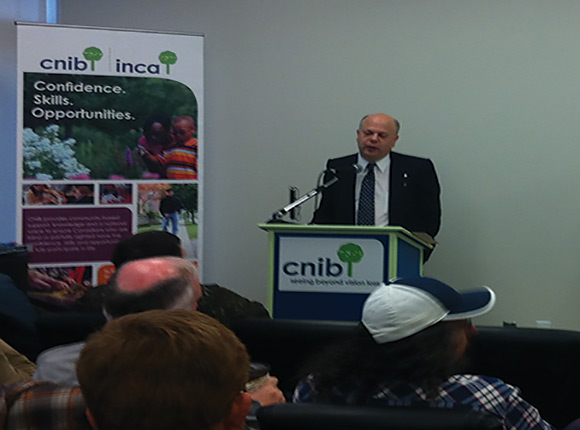
Author, lawyer and motivational speaker David Lepofsky is encouraging Nova Scotians to be advocates for a provincial disability act.
He declared the meeting the birth of the Nova Scotians with Disabilities Act movement.
“Most people running programs don’t have a disability themselves. Even if they think about us they don’t know what to do,” says Lepofsky.
“We need a law that makes sure the standards of accessibility that are set are informed by the real life experience of people with disabilities who face these barriers.”
Lepofsky, discussed strategies for advocating for a strong disability accessibility law for Nova Scotia.
He gave his recommendations to ensure that this act becomes a reality in Nova Scotia.
“Imagine walking into a government health office, white cane in hand, and having the very nice clerk hand you a number and say ‘Watch the screen for when your number comes up,’” says Lepofsky.
“People with disabilities face barriers in this country every single day of their lives. We have a right to live in a society free of barriers.
“That’s not just me speaking that is what the equality rights of our constitution says and that is what the human right’s code of every single province says.”
This is not a new idea in Nova Scotia.
Pat Gates, chair of the Canadian Council of the Blind Advocacy and Awareness Chapter says the Disabilities Strategy Partnership, which works with 22 provincial disability groups, has been working since 2009 to get a disabilities act passed.
“Persons with disabilities deserve to have the same access as persons without disabilities and we are not anywhere near that at this time,” says Gates.
“Persons with disabilities need to make up over half of any committee because we are the first voice. We can tell you exactly the inaccessible things that we come across because we live with it 24/7.”
Gates is legally blind. She says that because she has a white cane people often assume she can’t speak or think for herself.
“A lot of obstacles that persons with disabilities face is the false assumption that we can’t live like normal everyday people,” she says. “We are normal everyday people we just happen to have a disability.”
Lepofsky led a 10-year campaign in Ontario to get the province to pass a disabilities act. In 2001, Ontario became the first province in Canada to do so. He now leads the coalition that advocates to have the Accessibility for Ontarians with Disabilities Act effectively enforced.
Lepofsky encourages Nova Scotians to use Ontario’s act as a model, improve it and shape it for the province.
That’s what a group in Manitoba did and now Lepofsky says he understands a disabilities act will be passed in Manitoba by the end of the year.
Prior to the implementation of Ontarians with Disabilities Act in 2005, Lepofsky sued the Toronto Transit Commission (TTC) to announce all subway stops for the benefit of blind passengers.
After five years, he won.
Lepofsky says he had to sue the TTC a separate time in order to get them to announce all bus stops.
Lepofsky has given training to people with disabilities and their supporters across Ontario and elsewhere on how to win positive change, but that’s not enough.
“There are too many barriers and we will never get them all removed if we leave it to individuals with disabilities to have to sue one barrier at a time,” he says.
Lepofsky says barriers come about because organizations overlook people with disabilities. He says the disability act is designed to get people thinking about barriers early so problems are prevented before they happen.
A disability act would set accessibility standards which businesses and organizations would be forced to follow.
Dorothy Kitchen, co-chair of the Disability Strategy Partnership, says accessibility goes beyond ramps and the Access-A-Bus. It’s about having the technical aids needed to live independently.
Kitchen’s daughter uses a communication aid. With all of the accessories, it cost more than $20,000.
She received the device through charity and a church fundraiser because there were no options for any kind of government assistance
“Those are things that in other provinces they are covered in a lot of instances. That equipment should have been covered according to the convention,” says Kitchen.
This convention is the United Nations Convention on the Rights of Persons with Disabilities.
Article 26 of the convention states assistive technologies should be made accessible.
By Hanna Petersen: Published in the Halifax Commoner on November 7 2013.
 Hanna Petersen